
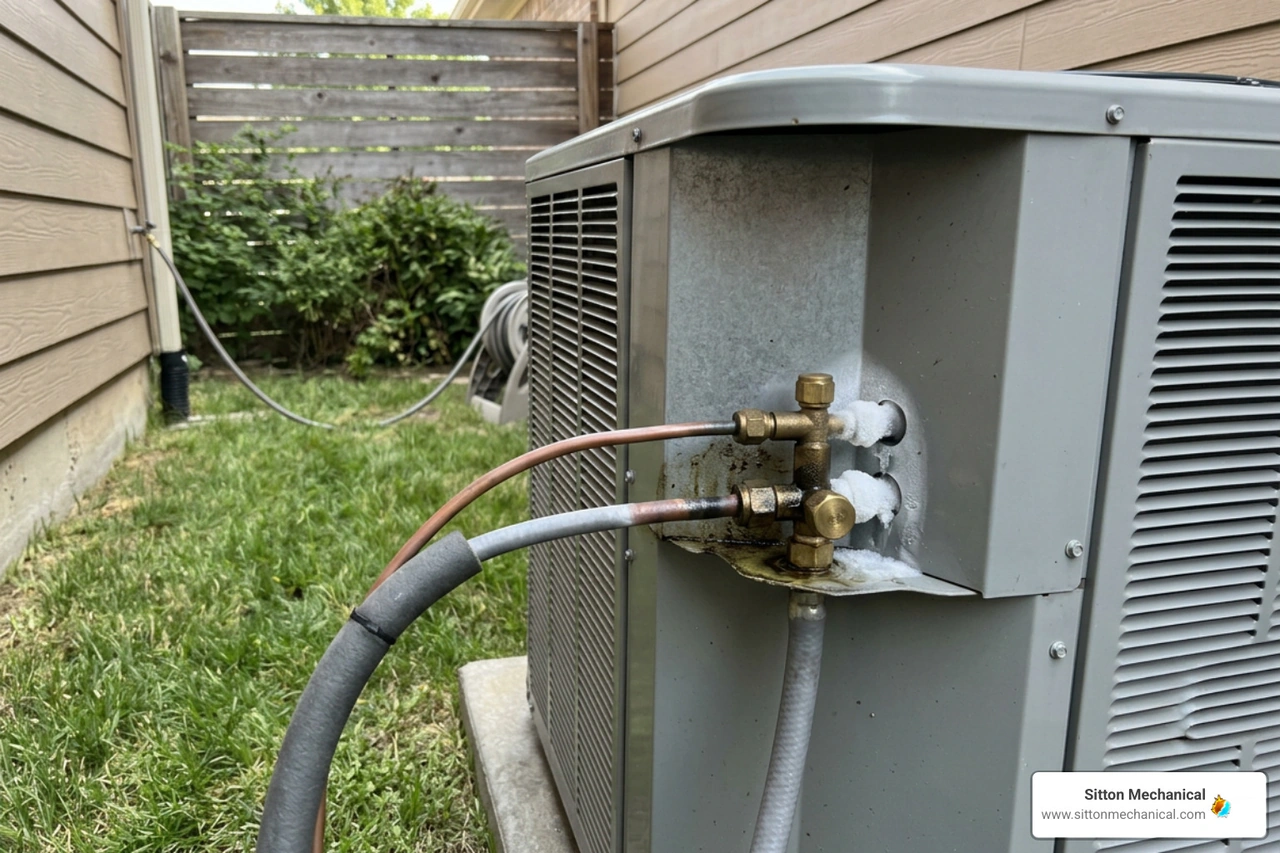
When Your AC Stops Cooling: Understanding Freon Leaks in Cushing
If you're dealing with an AC Freon leak in Cushing, here's what you need to know right away:
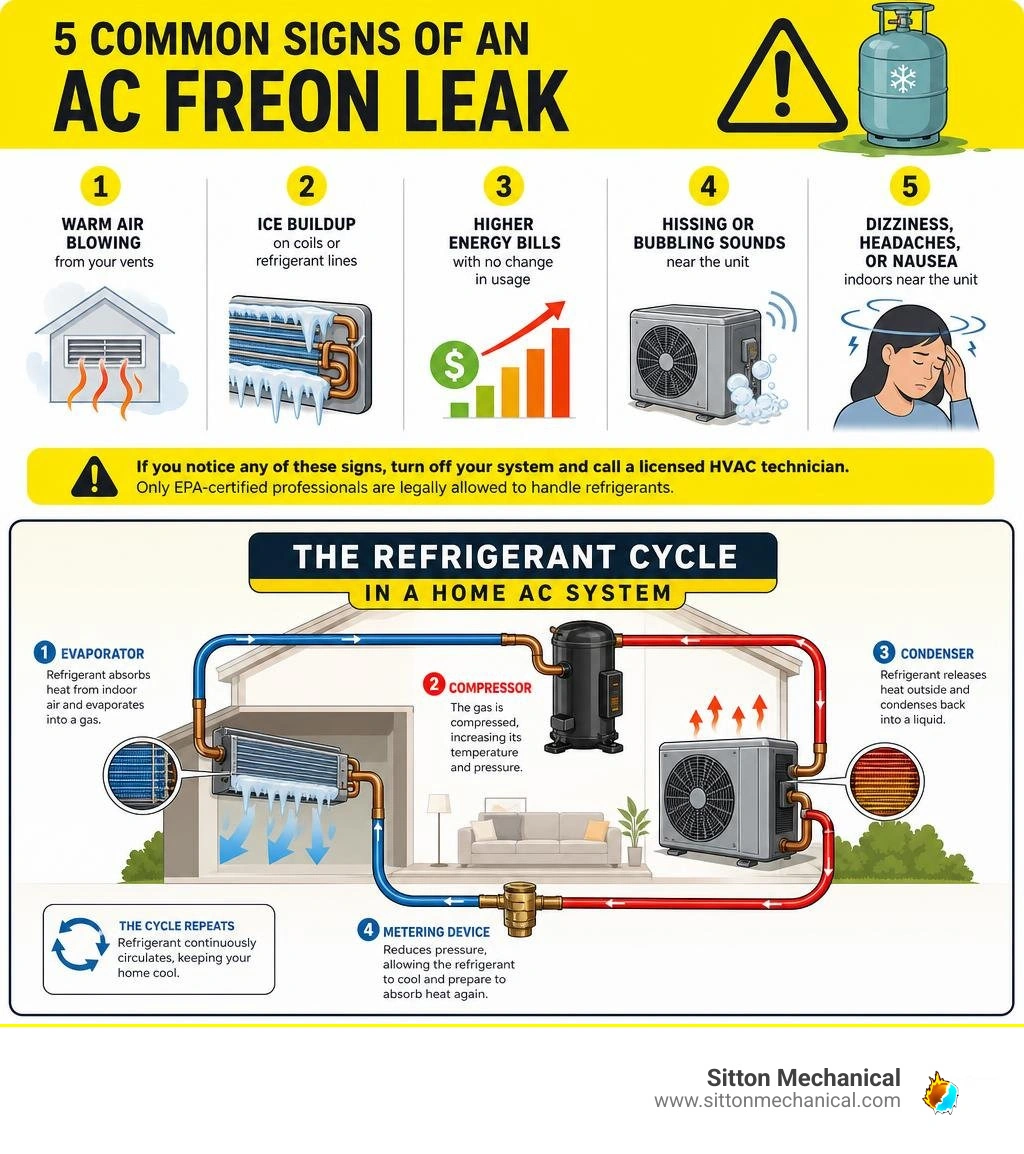
Quick Answer: Signs You Have a Refrigerant Leak
- Warm air blowing from your vents even when the AC is running
- Ice buildup on the evaporator coils or refrigerant lines
- Higher energy bills with no change in usage
- Hissing or bubbling sounds near the indoor or outdoor unit
- Dizziness, headaches, or nausea indoors near the unit
If you notice any of these, turn off your system and call a licensed HVAC technician. Only EPA-certified professionals are legally allowed to handle refrigerants.
Your AC doesn't consume refrigerant — it circulates it. So if the charge is low, there's a leak somewhere in the system.
The problem is more common than most homeowners expect. Research from the San Francisco Bay Area found that roughly 3.2% of residential central AC units leak enough refrigerant each year to trigger a service call. And while most leaks are small, the top 1% of leaks account for a staggering 80% of total greenhouse gas emissions from residential AC systems.
In Cushing, where summers are hot and your AC works hard for months at a time, even a slow leak can quietly drain your system's efficiency — and your wallet.
I'm Richard Sitton, and in this guide I'll walk you through exactly how to spot, diagnose, and address a refrigerant leak in your home.
Handy ac freon leak cushing terms:
Root Causes of Refrigerant Leaks in Residential and Automotive Systems
Refrigerant leaks occur in sealed mechanical systems when stress, chemical reactions, or mechanical fatigue weaken closed loop tubing and seals. Whether in residential central air conditioners or vehicle climate control loops, understanding why leaks form helps identify vulnerabilities before complete system failure occurs.
Mechanical Wear and Coil Corrosion
In residential central air conditioning systems, the indoor evaporator coil and outdoor condenser coil undergo continuous temperature swings and pressure shifts. Over years of seasonal operation, copper tubing, aluminium fins, and soldered joints experience thermal expansion and contraction.
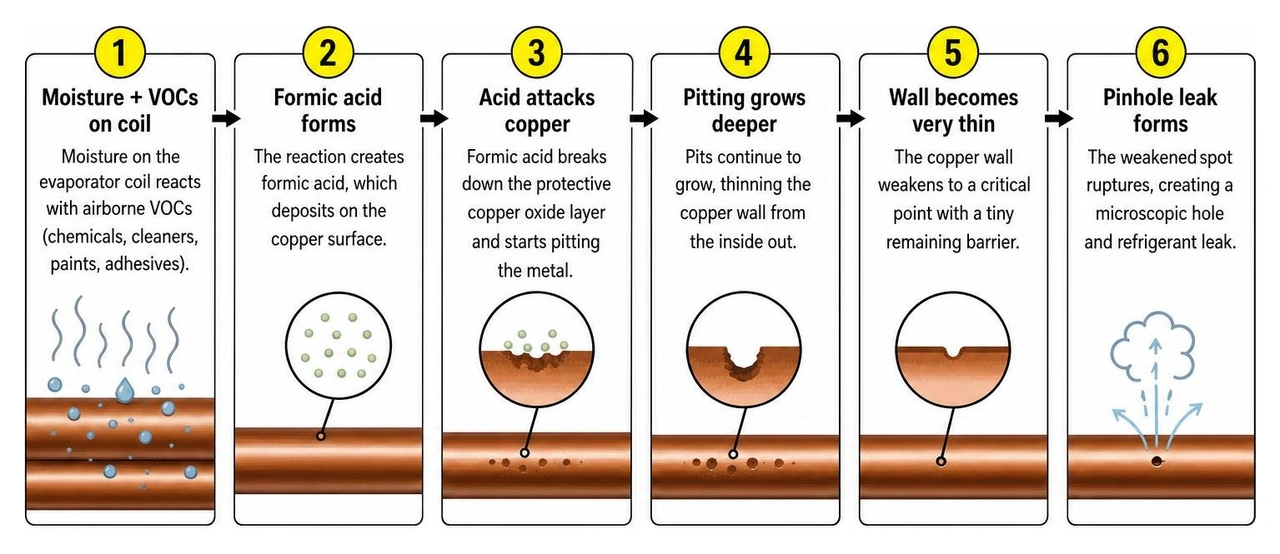
A primary driver of indoor coil failure is formic acid corrosion (often called formicary corrosion). This chemical reaction occurs when moisture on the evaporator coil reacts with volatile organic compounds (VOCs) commonly found in household air—such as cleaners, paints, adhesives, and building materials. This interaction produces microscopic formic acid deposits that pit the copper tubing, creating invisible pinhole leaks.
In addition to corrosion, operational factors contribute to joint fatigue:
- Physical Line Vibration: Constant vibration from the outdoor compressor motor can cause friction where copper lines rub against cabinet walls or support brackets.
- Thermal Shock: Quick cycles between blistering Oklahoma summer heat and cold internal refrigerant flow weaken braze joints.
- Factory Defects: Rare manufacturing defects, such as thin copper walls or improper factory solders, can surface after several years of operation.
To learn more about how mechanical fatigue leads to major system component damage, read our guide on what causes ac compressor failure.
Automotive and Specialized AC Leak Vectors
While residential systems use rigid copper and aluminum lines, automotive AC systems rely on flexible rubber hoses, O-rings, and rotating shaft seals to accommodate engine movement. These components present distinct leak vectors.
In vehicles, compressor shaft seals are vulnerable to failure when oil degrades or debris enters the system snout. Technical guidance like the A/C Compressor Failure TSB highlights how oil residue escaping past the shaft seal signals immediate loss of system integrity. For instance, testing procedures require technicians to use paper absorption tests on felt washers and run calibrated electronic sniffers around the compressor snout for at least 5 minutes to confirm microscopic seal leakage.

Similarly, complex automotive systems face alignment and seal issues. As detailed in the 167 Air Conditioning System Leak TSB, minor bending of expansion valve mounting brackets or improper seal seating can produce minor leaks below 50 parts per million (ppm). Diagnosing these microscopic leaks requires precise forming gas leak checks rather than unapproved tracer dyes, ensuring accurate location without contaminating the refrigerant loop.
Common Causes of an AC Freon Leak in Cushing Homes
Homes across Cushing, Stillwater, Perkins, and surrounding areas experience significant weather variations, from severe spring storms to intense summer heat waves. These local environmental factors accelerate wear on cooling systems.
The main causes of an ac freon leak cushing home systems experience include:
- Severe Weather and Environmental Stress: High humidity levels during central Oklahoma summers increase moisture accumulation on indoor coils, accelerating chemical pitting.
- Vibration along Long Line Sets: Standard factory pre-charged refrigerant line sets are designed for approximately 15 feet. Custom installations with longer tubing runs experience higher physical movement and vibration stress along joint connection points.
- Joint Friction and Stress: Outdoor condenser units sitting on settling ground pads can put uneven strain on copper line connections.
- Corrosion from Household VOCs: Modern tightly sealed, energy-efficient homes can trap indoor air pollutants, concentrating organic acids on the wet evaporator coil.
When these factors weaken your system's integrity, professional repair is required. You can trust our local technicians for expert ac repair cushing ok services to quickly resolve refrigerant loss issues.
Step-by-Step Troubleshooting for an AC Freon Leak in Cushing
If you suspect your air conditioner is losing refrigerant, you can perform several basic observations before contacting a licensed technician. Follow this step-by-step evaluation process:
- Step 1: Check Thermostat and Supply Vent Temperature. If your thermostat is set to cool but the air blowing from your supply vents feels warm or room-temperature, your system is likely lacking the refrigerant necessary to absorb heat.
- Step 2: Inspect the Indoor Evaporator Coil and Copper Lines. Look for frost or thick ice accumulation along the copper refrigerant lines leading to the outdoor unit or on the indoor air handler cabinet. When refrigerant charge drops, operating pressures plunge below the freezing point, causing ambient humidity to freeze on the coils.
- Step 3: Listen closely near System Components. Listen near both the indoor air handler and outdoor condenser for distinct hissing or bubbling noises, which indicate pressurized gas escaping through copper fissures or loose valves.
- Step 4: Check Household Energy Consumption. Review your monthly electric bill. An air conditioner running on low refrigerant will operate continuously without reaching the thermostat setpoint, leading to an unexpected spike in electricity usage.
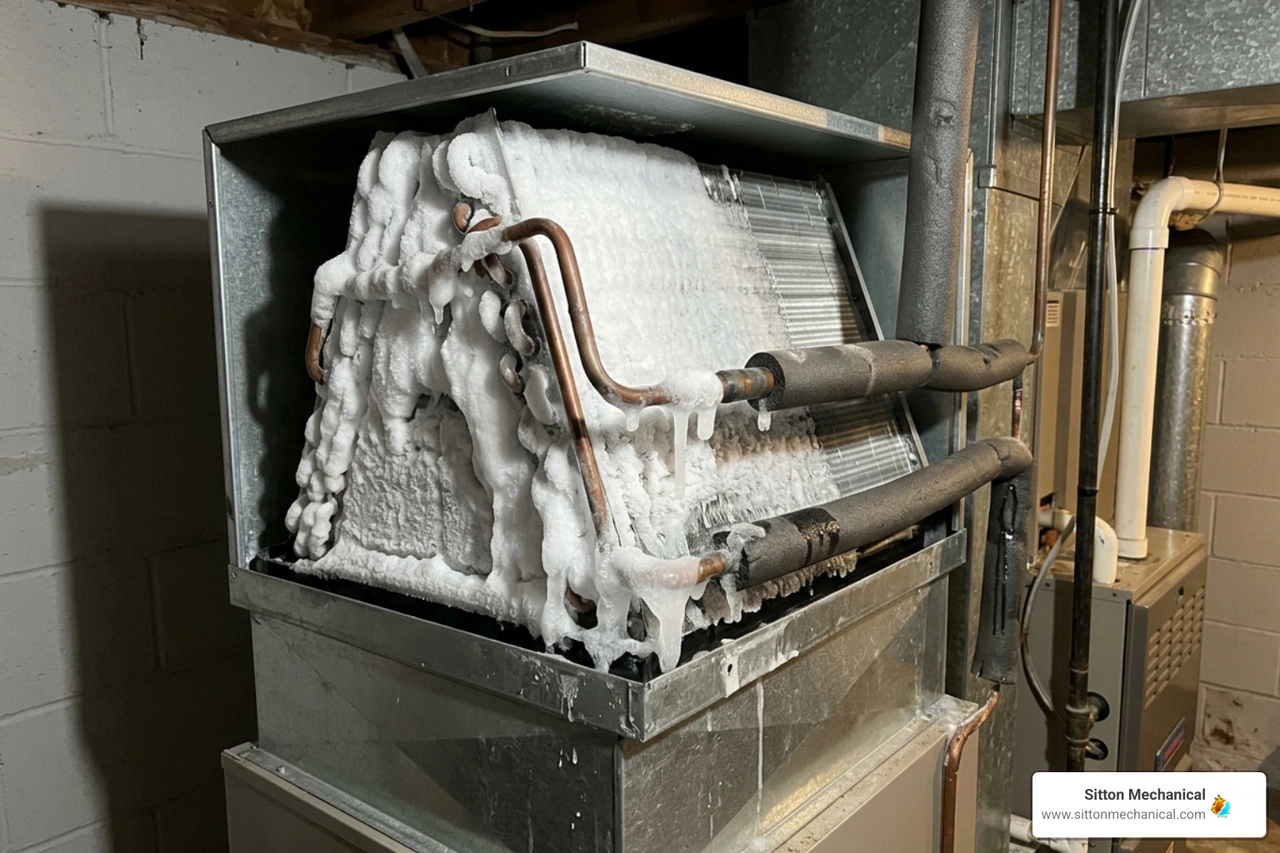
For a deeper look into identifying these warning signs early, review our guide on low refrigerant signs in your ac system.
Professional Solutions for an AC Freon Leak in Cushing
While homeowners can spot superficial signs of low refrigerant, locating precise leak sites requires specialized equipment and technical expertise.
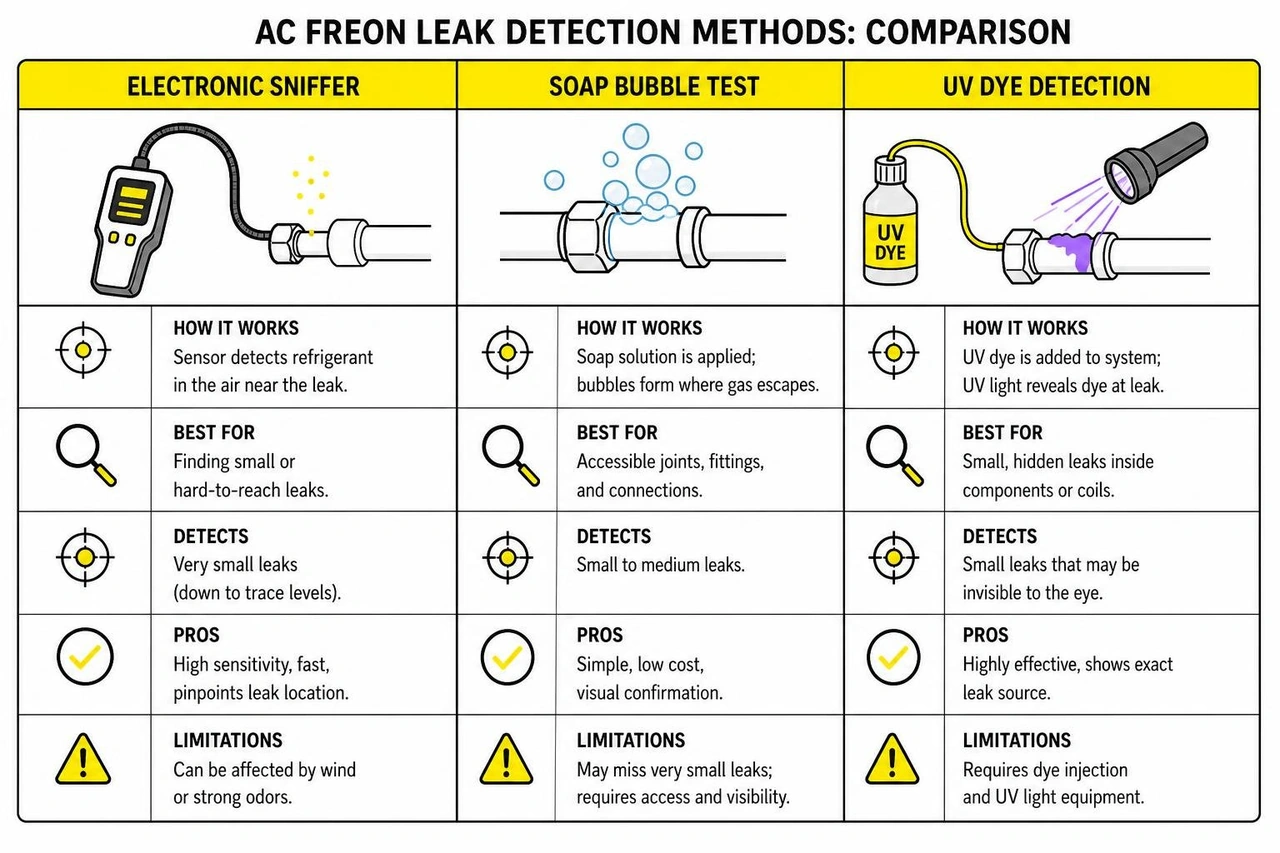
When our certified technicians arrive at your home, we utilize advanced diagnostic tools to locate the leak:
- Electronic Sniffer Detection: We calibrate electronic leak detectors capable of sensing minute chemical concentrations (down to fractions of an ounce per year) around braze joints, service valves, and coil return bends.
- Soap Bubble Testing: Applying a specialized high-viscosity soap solution to suspected fitting points produces visible, expanding bubbles where escaping gas creates surface tension.
- Ultraviolet (UV) Dye Injection: Injecting an EPA-approved fluorescent dye into the refrigerant stream allows us to use an ultraviolet light inspection lamp to reveal oily dye stains at the precise leak origin.
- Forming Gas Testing: In complex cases, we isolate system sections, evacuate remaining gas, and charge the loop with a non-flammable nitrogen-hydrogen forming gas mixture to trace sub-50 ppm leaks.
Watch this useful Leak Detection Video Guide to see how modern diagnostic equipment isolates escaping gas. For additional guidance on resolving cooling issues, check our overview on troubleshooting ac refrigerant leak signs.
Health Risks, Environmental Impact, and Regulations
Refrigerant leaks affect more than just indoor comfort—they present safety risks and potential environmental impacts when improperly managed.
Refrigerants are heavier-than-air chemical compounds. In the rare event of a sudden, severe indoor coil rupture, escaping refrigerant gas displaces oxygen in lower living spaces. Exposure to high concentrations can cause headaches, dizziness, nausea, eye irritation, and respiratory distress. Research indicates that complete indoor loss of refrigerant charge is rare—occurring in roughly 0.02% of homes per year (about 1 in 5,000)—but immediate room ventilation and professional inspection are essential if a major leak occurs.
From an environmental standpoint, older legacy refrigerants carry significant risks:
- R-22 (Freon): An HCFC refrigerant containing chlorine that damages the earth's protective stratospheric ozone layer. R-22 has been phased out under international agreements.
- R-410A (Puron): An HFC refrigerant that does not deplete ozone, but possesses a high Global Warming Potential (GWP)—over 2,000 times greater than carbon dioxide pound for pound.
Under the federal AIM Act, high-GWP HFC refrigerants like R-410A are being systematically phased down in favor of next-generation low-GWP refrigerants, such as R-32 and R-454B.
Comparing Residential and Commercial Leak Impacts
Refrigerant leakage dynamics vary significantly between residential central AC systems and high-pressure commercial refrigeration systems.
Empirical measurements from the Residential Refrigerant Leakage Study demonstrate that operational leakage in home air conditioners is lower than historic modeling suggested, but leaks follow an extreme long-tail distribution:
| Feature / Characteristic | Residential Central AC Systems | Commercial Refrigeration Systems |
|---|---|---|
| Average Annual Leak Rate | ~1.78% of total charge annually | 10% – 25% of total charge annually |
| Leak Distribution | Highly skewed: Top 1% of leaks cause 80% of total emissions | Broadly distributed across extended piping and rack systems |
| Primary Leak Locations | Evaporator coil pinholes, flared connections, service valves | Receiver valves, compressor rack seals, long line runs |
| Typical Refrigerant Type | R-22, R-410A, R-454B, R-32 | R-404A, R-507A, CO2 (R-744), Ammonia |
| Service Trigger Rate | ~3.2% of units experience annual service-triggering leaks | Regular continuous leak monitoring required by law |
Because the vast majority of residential greenhouse gas emissions stem from catastrophic "top 1%" leak events, prompt professional intervention when an ac freon leak cushing occurs is critical for minimizing environmental impact.
Safety and Regulatory Standards
Federal law strictly regulates the handling, recovery, and recycling of HVAC refrigerants. Under Section 608 of the Clean Air Act:
- It is illegal to knowingly vent or release refrigerants into the atmosphere during maintenance, repair, or disposal.
- Only EPA Section 608 certified technicians are legally authorized to purchase refrigerants, connect gauge manifolds to pressurized loops, or perform system recharges.
- Refrigerant recovered during repairs must be processed using certified recovery equipment and sent to approved reclamation facilities.
Our certified team adheres strictly to these federal environmental compliance guidelines on every service call.
Repair Options, Maintenance, and System Upgrades
When a refrigerant leak is identified in your Cushing home, choosing the right repair strategy depends on the age of your equipment, the location of the leak, and the type of refrigerant your system uses.
Standard professional repair methods include:
- Braze Repairing Copper Lines: If a leak is located at an accessible copper braze joint or straight line tubing run, the technician evacuates the system, repairs the leak with high-temperature silver brazing alloy, vacuums the system to removes moisture, and recharges the correct refrigerant.
- Replacing the Evaporator or Condenser Coil: Pinhole leaks caused by formicary corrosion across aluminum or copper fins generally cannot be permanently brazed. Replacing the entire factory coil assembly is required to restore long-term reliability.
- Replacing Valve Stems or Schrader Cores: Leaks occurring at service port cores or expansion valve fittings are resolved by replacing the damaged valve cores or bracket seals using proper torque specifications.
Repairing vs. Upgrading Leaking Systems
When deciding whether to repair a leaking system or upgrade to a modern air conditioner, consider these key evaluation factors:
- Refrigerant Type: If your system runs on phased-out R-22 refrigerant, supply shortages make sourcing chemical recharges increasingly impractical. Upgrading to a modern system operating on eco-friendly refrigerants like R-454B or R-32 offers better long-term reliability.
- System Age: Air conditioners older than 10 to 12 years that experience coil leaks are often nearing the end of their design lifespan. Investing in major component replacement on an aging system may lead to subsequent component failures later.
- Overall System Integrity: If an AC system operated for an extended period with low refrigerant, the compressor may have suffered thermal strain due to lack of cooling gas and oil circulation.
Proactive Maintenance for Leak Prevention
Routine preventive maintenance helps protect your air conditioner against structural failure and chemical corrosion:
- Replace Air Filters Regularly: Change return filters every 1 to 3 months. Clean air filters prevent airflow restrictions that cause evaporator coils to freeze up.
- Keep Outdoor Units Clear: Maintain a 2-foot clearance around your outdoor condenser pad, removing leaves, weeds, and storm debris that impede heat release.
- Schedule Annual Tune-Ups: Comprehensive seasonal inspections allow technicians to clean coils, inspect electrical contacts, measure operating pressures, and catch small vibration leaks before complete refrigerant loss occurs.
Schedule your seasonal tune-up using our ac maintenance cushing ok guide 2026 to keep your cooling system running at peak performance.
Frequently Asked Questions About Refrigerant Leaks
Can I top off my AC refrigerant without fixing the leak?
No, simply topping off refrigerant without repairing the leak is ineffective and violates environmental regulations. Because air conditioners operate as closed loops, escaping refrigerant indicates an active opening in the system. Adding refrigerant without sealing the leak results in continuous gas loss, potential compressor damage from oil loss, and illegal venting into the atmosphere.
Is a refrigerant leak hazardous to my family's health?
Small, slow outdoor leaks pose minimal health risks to occupants. However, a sudden leak from an indoor evaporator coil can release chemical vapors into your living space. Refrigerants displace oxygen in enclosed areas, which can cause symptoms such as dizziness, headache, or nausea. If you smell a unusual chemical odor or hear severe hissing from your indoor unit, turn off the system, open windows for ventilation, and call an HVAC professional.
How do I know if my AC coil is leaking or just dirty?
A dirty evaporator coil restricts airflow, causing weak airflow from supply vents and moderate cooling loss. However, a dirty coil without a refrigerant leak will still maintain correct operating pressure balances when checked by a technician. A leaking coil causes physical ice accumulation along line sets, hissing sounds, and a drop in system operating pressure. A certified technician uses electronic leak sniffers or pressure testing to confirm whether a coil is leaking or simply needs cleaning.
Conclusion
A refrigerant leak compromises home comfort, lowers system efficiency, and can lead to major component failures if left unaddressed. Understanding the causes of refrigerant leaks—from coil corrosion to joint fatigue—helps you spot early warning signs like warm vent air, ice accumulation, and rising utility bills before total system breakdown occurs.
When you need prompt, reliable cooling service in Cushing, Stillwater, Perkins, Morrison, Perry, or surrounding communities, trust the experienced team at Sitton Mechanical, LLC. With over a decade of industry expertise, our background-checked, EPA-certified technicians provide upfront pricing, guaranteed workmanship, and fast service to restore your air conditioning system safely.
Don't let a refrigerant leak compromise your indoor comfort this summer. Visit our locations cushing page or contact us today to schedule your comprehensive AC diagnostic and repair service!