Is Your Stillwater Furnace Ready for Another Heating Season?
Furnace cleaning in Stillwater is something every homeowner should schedule at least once a year — ideally before the heating season begins in fall.
Quick answers for Stillwater homeowners:
- How often: Once a year, before heating season (late summer or early fall is ideal)
- What it does: Removes dust, debris, and buildup from burners, heat exchangers, blower motors, and filters
- Why it matters: Improves safety, lowers energy bills, extends furnace life, and protects indoor air quality
- Who should do it: A certified HVAC technician — not a DIY project for most homeowners
- Best time to book: July or August, before the fall rush hits
Minnesota winters are no joke. Stillwater homeowners rely heavily on their furnaces for months at a time — and that heavy use takes a toll. Dust, debris, and buildup quietly accumulate inside your system while it sits idle through summer.
Here's the problem most people don't think about: the EPA estimates that Americans spend 90% of their time indoors, and the air inside the average home can be up to 100% more polluted than outdoor air. A dirty furnace is one of the biggest contributors to that problem — circulating dust, allergens, and combustion byproducts every time it runs.
By July 2026, if your furnace hasn't been cleaned since last heating season, now is the right time to get ahead of it.

Related content about furnace cleaning stillwater:
Why Stillwater Homes Require Regular Furnace Cleaning
The air we breathe inside our homes is often a silent contributor to chronic allergies, fatigue, and respiratory discomfort. While outdoor air pollution gets the majority of public attention, indoor air quality is frequently much worse. According to the Environmental Protection Agency (EPA), household air pollution is a significant global issue, contributing to millions of respiratory illnesses annually.
In fact, a landmark 2019 study from the University of Colorado Boulder revealed that everyday household activities—such as cooking, cleaning, and walking across carpeted floors—can kick up enough particulate matter to put indoor air quality on par with that of a polluted major city. When you combine this with the fact that modern homes are tightly sealed to keep conditioned air inside, you have a recipe for stagnant, pollutant-heavy air.
Every time your heating system kicks on, it draws in air, heats it, and distributes it throughout your living space. If your heating unit has accumulated months of dust, pet dander, pollen, and hair, it acts as a giant distribution hub for these allergens. Understanding why heating maintenance is essential starts with recognizing that your HVAC system is the lungs of your home.
Over time, this continuous cycle of dust accumulation does more than just trigger sneezes; it directly hurts your pocketbook. A thick layer of dust on your furnace components acts as an insulating blanket in the worst way possible. It forces your system to work significantly harder to heat the air, which directly compromises your furnace efficiency stillwater. When components must run longer and hotter to achieve the target temperature on your thermostat, your monthly utility bills climb, and the overall lifespan of your heating system is dramatically shortened.
Regular professional cleaning clears away this insulating debris, restoring smooth, unhindered heat transfer and keeping your energy consumption to a minimum.
The Importance of Professional Furnace Cleaning Stillwater

Many homeowners wonder when the best time is to schedule professional heating maintenance. While we perform service year-round, late summer and early autumn represent the ideal seasonal window. Scheduling your service during July, August, or September ensures your system is clean and fully operational before the first freezing night arrives.
Waiting until the dead of winter to address a dirty system often leads to unpleasant surprises. Recognizing the signs you need HVAC repair before a total breakdown occurs can save you from emergency situations.
Keep an eye out for these common warning signs that indicate your system is overdue for a professional cleaning:
- Visible dust around your vents: If you notice a fine layer of gray dust accumulating on your supply registers or return grilles, it is a clear sign your system is overloaded with airborne particles.
- Strange noises coming from the cabinet: High-pitched squeals, rattling, or clicking sounds often point to dirty blower wheels, restricted airflow, or debris interfering with the burner assembly.
- Short cycling: If your system turns on and off rapidly without ever fully warming your home, restricted airflow from a dirty filter or clogged internal components is likely causing the system to overheat and shut down prematurely as a safety precaution.
- Uneven heating: Dust and soot buildup on the burners can prevent them from igniting cleanly, leading to inconsistent temperatures from room to room.
Ignoring these warning signs and neglecting regular furnace maintenance Stillwater OK does more than just lower your comfort—it can introduce serious safety hazards to your household.
The combustion process in gas heating systems naturally produces carbon monoxide (CO), a colorless, odorless, and highly toxic gas. In a clean, well-maintained system, these combustion byproducts are safely vented out of your home through the flue pipe. However, if burners are choked with soot or the heat exchanger becomes cracked due to excessive heat stress from restricted airflow, carbon monoxide can escape into your living space. Professional cleaning and inspection are your primary defenses against these silent hazards.
What To Expect During a Professional Furnace Cleaning Service
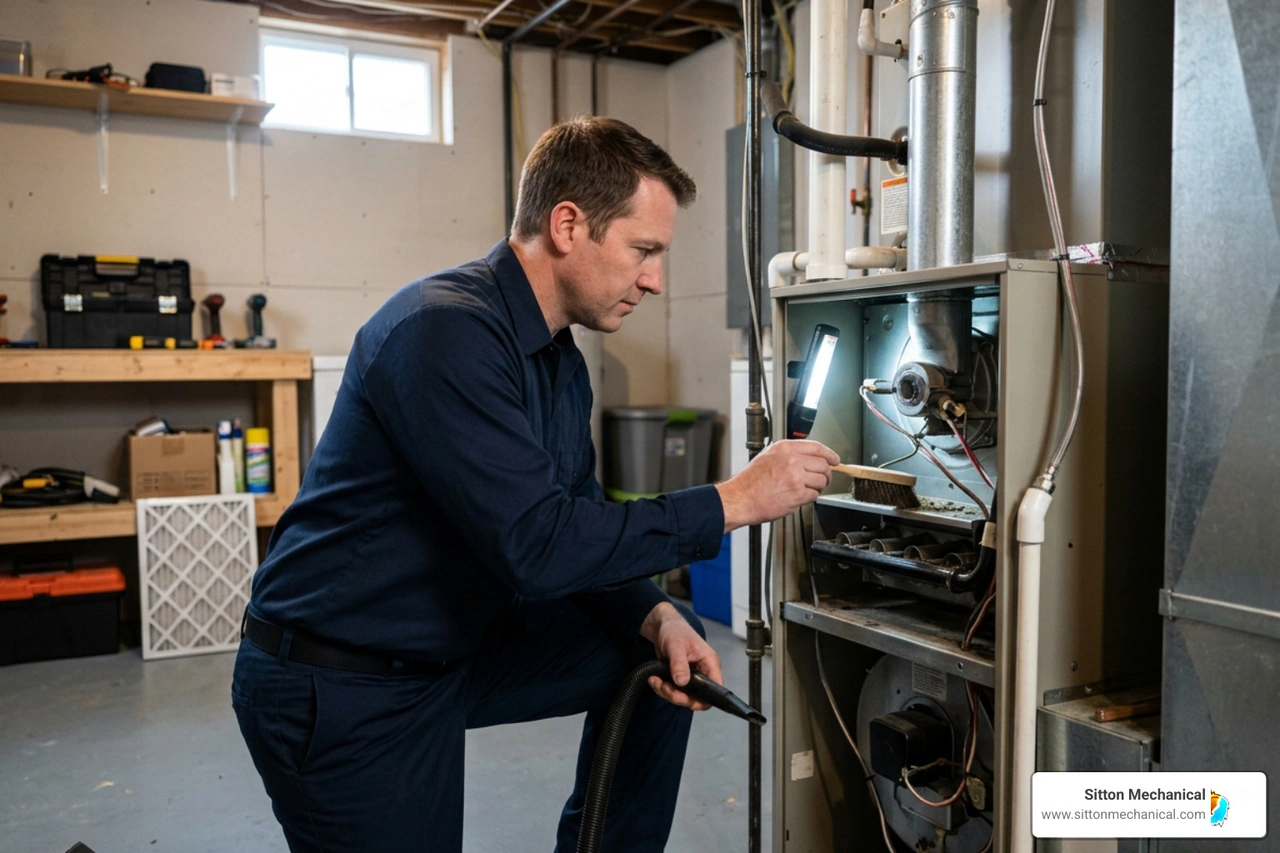
A comprehensive professional cleaning is far more involved than simply changing an air filter or vacuuming out the bottom of the cabinet. When our certified technicians perform a cleaning, they conduct a multi-point inspection and deep-clean vital internal mechanisms that are difficult and dangerous for an untrained homeowner to access.
To help clarify how different home maintenance tasks interact, here is a comparison of how furnace cleaning differs from other common indoor air quality services:
| Service Type | Primary Focus | Key Components Cleaned | Main Benefit |
|---|---|---|---|
| Furnace Cleaning | Heating unit performance and combustion safety | Burners, heat exchanger, blower motor, flame sensor | Restores heating efficiency, prevents system breakdowns, ensures combustion safety |
| Duct Cleaning | Air distribution network | Supply and return ductwork, register grilles | Removes accumulated dust, pet dander, and allergens from the air pathways |
| Vent Cleaning | Exhaust and exhaust safety | Flue pipes, dryer vents, combustion exhaust lines | Prevents carbon monoxide backup, eliminates fire hazards from lint or soot blockage |
During a standard service visit, we also perform safety shutoff testing. This ensures that if your system ever experiences a dangerous condition—such as a failing blower motor or an overheating heat exchanger—the safety switches will instantly cut power and fuel to the unit, protecting your property and family.
Step-by-Step Guide to Furnace Cleaning Stillwater
When you book a professional furnace tune up Stillwater OK with our team, our technicians follow a rigorous, step-by-step process to ensure no component is overlooked:
- System Inspection and Safety Shutdown: We begin by running the system briefly to observe its operating cycle, checking for unusual noises or odors. We then completely shut off the electrical power and gas supply to ensure a safe working environment.
- Heat Exchanger Inspection: We use specialized cameras to examine the heat exchanger for any signs of corrosion, soot buildup, or physical cracks that could leak flue gases.
- Blower Motor and Wheel Cleaning: The blower motor is responsible for pushing warm air through your home. Dust on the blower blades can cause the wheel to become unbalanced, putting strain on the motor. We carefully pull the assembly, clean the blades, and lubricate any moving parts if necessary.
- Burner Assembly and Flame Sensor Calibration: We clean the individual burners to remove rust and soot, ensuring a clean, blue flame. We also gently clean the flame sensor—a small metal rod that detects combustion. A dirty flame sensor will fail to recognize a flame, causing your system to shut down immediately after lighting.
- Filter Check and Replacement: We inspect your current air filter, replacing it if it is dirty, and discuss the best filter options for your household's specific needs.
- Final Testing and System Startup: Once everything is clean and reassembled, we restore power and fuel, test the system through a full heating cycle, and check for proper airflow and safe combustion levels.
How Furnace Cleaning Differs from Duct and Vent Cleaning
It is common for homeowners to confuse furnace cleaning with duct cleaning or dryer vent cleaning. While all three services work together to improve your home's air quality and safety, they target completely different parts of your property.
- Furnace cleaning focuses strictly on the cabinet of your heating system—the mechanical heart that generates and moves the heat.
- Duct cleaning targets the pathways (usually hidden behind your walls and under your floors) that carry that air to your rooms. If you have recently completed a home renovation or have severe pet allergies, scheduling professional duct cleaning can prevent construction dust and pet hair from immediately clogging your freshly cleaned heating unit.
- Vent cleaning refers to clearing out exhaust pathways, such as your dryer vent or your heating system's flue pipe. Over time, restricted airflow in a dryer vent can cause heat to build up, presenting a severe fire risk. Similarly, keeping your heating flue clear ensures that dangerous combustion gases have an unobstructed path out of your home.
Best Practices and Frequently Asked Questions

Maintaining a comfortable and safe home requires a combination of professional maintenance and smart homeowner habits. By following industry best practices and staying on top of simple tasks between professional visits, you can ensure your heating system remains in peak condition for years to come.
To help you stay on track, we have compiled some of our top furnace maintenance tips and answered the questions we hear most often from local homeowners.
Choosing the Right Partner for Furnace Cleaning Stillwater
Your heating system is one of the most expensive and critical pieces of equipment in your home. When it comes to maintaining it, you want to make sure you are working with a team you can trust.
When searching for a local service provider, look for the following qualifications:
- Screened and Certified Technicians: Ensure the technicians entering your home have undergone background checks and hold industry-recognized certifications.
- Upfront Pricing: A reputable company will always provide clear, transparent pricing before any work begins, so you never have to worry about hidden fees or surprise charges.
- Guaranteed Workmanship: Look for companies that stand behind their services with solid guarantees, giving you peace of mind that the job will be done right the first time.
- Local Experience: Working with a local team means they understand our regional climate demands and the specific heating challenges that local homeowners face.
Keeping your system running smoothly is simple when you invest in routine HVAC maintenance Stillwater OK.
How often should I replace my furnace filter between professional cleanings?
As a general rule of thumb, you should check your air filter once a month and replace or clean it at least every 30 to 90 days. However, the ideal frequency depends heavily on the type of filter you use and your household dynamics:
- Standard 1-inch pleated filters: These should typically be replaced every 30 to 60 days.
- Homes with pets or allergy sufferers: If you have dogs or cats, pet dander will clog your filter much faster. We recommend checking your filter every 30 days.
- Thicker media filters (4 to 5 inches): These high-capacity filters can often last anywhere from 6 months to a year before needing a replacement.
Using high-efficiency filters is a great way to capture smaller airborne particles, but you must be careful not to restrict your system's airflow. Standard systems are designed for specific airflow rates; installing a filter with a MERV rating that is too high can act like a wall, forcing your blower motor to work harder and potentially causing your system to overheat.
For more details on keeping your system running smoothly, check out our guide on HVAC maintenance for optimal performance.
Can a dirty furnace cause carbon monoxide leaks?
Yes, a dirty furnace can indirectly lead to carbon monoxide leaks. When dust and soot accumulate on your burners, it prevents proper combustion, which can cause the system to produce higher levels of carbon monoxide.
Furthermore, if your system's airflow is restricted by a severely clogged filter or dirty internal components, the heat exchanger will experience excessive heat stress. Over time, this constant overheating and cooling causes the metal of the heat exchanger to expand and contract violently, eventually leading to hairline cracks.
These cracks allow toxic combustion gases, including carbon monoxide, to mix directly with the air being blown into your living spaces. If your heat exchanger is compromised, a professional furnace replacement Stillwater OK is often the safest and most reliable solution to protect your household.
To safeguard your family, always ensure you have working carbon monoxide detectors installed on every level of your home, especially near sleeping areas, and test them monthly.
Conclusion
A clean heating system is the foundation of a safe, comfortable, and energy-efficient home. By investing in regular maintenance, you can lower your energy bills, extend the lifespan of your system, and breathe easier knowing your indoor air is clean and free of hazards.
At Sitton Mechanical, LLC, we bring more than 10 years of experience to every job, serving homeowners across Stillwater, Perkins, Morrison, Glencoe, Perry, Cushing, Mulhall, Orlando, Ripley, and Sumner. Our team of screened, certified technicians is dedicated to providing upfront pricing, guaranteed work, and on-time service you can count on.
Don't wait for the cold weather to catch you off guard. If your heating system is making strange noises, blowing dusty air, or simply overdue for its annual checkup, we are here to help. Contact us today or visit our furnace repair Stillwater OK page to schedule your professional service and keep your home warm and safe all year long.